By Gabriella Arce Rodriguez and Marianna Arce Rodriguez, founders of Calm Heart Studio
Yes, Pilates can help with weight loss, but it works best as one part of the plan, not the whole plan. Research shows that regular Pilates can lower body weight and body fat, mostly because it builds strength and is easy to keep doing week after week. On its own, though, a Pilates class burns fewer calories than running or cycling. You’ll get the best results by pairing Pilates with some strength or cardio work, everyday movement, good sleep and balanced eating.
It’s one of the most common questions people ask about Pilates, especially in January. Here’s the honest answer, along with what the research actually says.
Key takeaways
- A 2021 review of 11 studies found that people who did Pilates for 8–24 weeks lost on average about 2.4 kg more, and lowered their body fat more, than people in comparison groups.
- A typical Pilates class burns fewer calories than cardio. In one lab study, a Reformer session burned about a third more than a mat session.
- Pilates helps most by building strength and a routine you’ll stick with.
- For weight loss, combine 2–3 Pilates classes a week with strength or cardio work, daily movement, sleep and balanced meals.
- Expect to feel stronger within a few weeks. Changes on the scale usually take longer.
What the research says about Pilates and weight loss
The best summary of the evidence is a 2021 meta-analysis published in Frontiers in Physiology. The researchers combined 11 randomized controlled trials involving 393 adults living with overweight or obesity. Most programs ran for 8 to 24 weeks, usually with about three hour-long Pilates sessions a week.
Compared with the comparison groups, the people doing Pilates:
- lost on average about 2.4 kg of body weight
- lowered their body fat percentage by about 4 percentage points
- lowered their BMI by just over 1 point
Two results did not change significantly: waist circumference and lean body mass. The authors also noted that most of the studies were small and of low to moderate quality, and called for larger, better-designed trials.
So the honest summary is: Pilates does help, the effect is real but modest, and it shows up over months of regular practice, not weeks.
Read the study: Pilates for Overweight or Obesity: A Meta-Analysis
How many calories does Pilates burn?
Fewer than most people expect. Pilates is controlled, precise work, and much of each class is spent setting up, breathing and holding positions.
In a 2021 lab study, 18 healthy young women did a mat session and a Reformer session of 15 exercises each, while researchers measured their oxygen use:
- The Reformer session burned about 2.6 calories a minute.
- The mat session burned about 1.9 calories a minute.
Over a 50-minute class, that works out to roughly 100–130 calories. The researchers described both sessions as low intensity for the heart and lungs. An earlier study for the American Council on Exercise (ACE) found something similar: 50-minute beginner and advanced mat classes reached 54% and 62% of participants’ maximum heart rate, and ACE’s chief exercise physiologist said a Pilates session “burns a relatively small amount of calories.”
These numbers depend on your body size, the class and the pace. A study session of separate exercises with rests isn’t the same as every class on a schedule. But the takeaway holds: if you choose Pilates only to burn calories, you’ll probably be disappointed. That isn’t where its value lies.
Read the study: energy expenditure of Reformer and mat Pilates
So how does Pilates help you lose weight?
If the calorie burn is modest, why did people in the studies lose weight and body fat? A few reasons:
- It builds strength. Pilates works your deep core, glutes, legs, back and arms, often against spring resistance on the Reformer. Canada’s physical activity guidelines recommend strength work for the major muscle groups at least twice a week, and Pilates counts.
- It’s something you’ll keep doing. Pilates is low-impact and every exercise has easier and harder options, so it’s easy on your joints and easy to come back to. Weight loss depends on consistency over months, and a workout you enjoy is one you’ll still be doing in March.
- It makes the rest of your training better. Better core control, posture and body awareness help you lift, walk, run and move with good form, and with less chance of being sidelined.
- It builds habits. A booked class is an appointment with yourself. Many of our members find that once Pilates is part of their week, other healthy habits follow: more walking, better sleep, more thought about what they eat.
Is Reformer Pilates better than mat Pilates for weight loss?
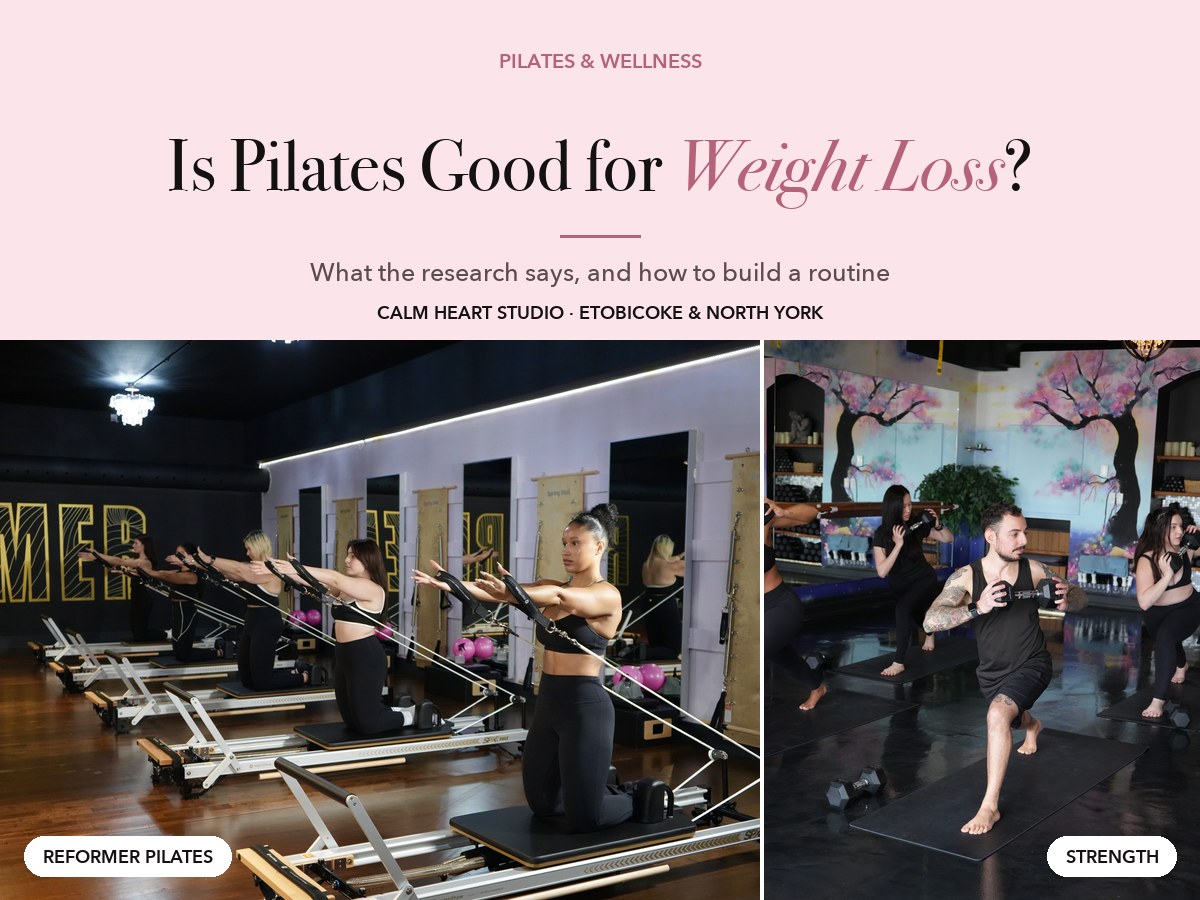
Reformer Pilates burned about a third more calories than mat Pilates in the study above, because the springs add resistance and the movements use more of your body at once. That resistance also makes the Reformer a good way to build strength.
But both work, and the best choice is the one you’ll go to regularly. Mat Pilates is a great place to learn the foundations, and many of our members do both. Read more about our Reformer Pilates classes and mat Pilates classes.
Pilates vs yoga vs the gym for weight loss
| Calorie burn per class | Main strength | Best role in a weight-loss plan | |
|---|---|---|---|
| Pilates | Low to moderate (higher on the Reformer) | Core strength, control and posture | Builds strength and a routine you’ll keep |
| Yoga | Low to moderate (higher in a flowing vinyasa class) | Flexibility, balance and breath | Mobility, recovery and stress relief |
| Strength training | Moderate | Building muscle | Adds strength work with heavier loads |
| Cardio (running, cycling, HIIT) | Higher | Heart and lung fitness | Burns the most calories per session |
No single option wins. The best results come from combining strength, cardio and recovery in a week you can actually keep up. If you’re deciding between Pilates and yoga, our guide to Pilates vs yoga explains the difference.
A sample weekly plan
Canada’s 24-Hour Movement Guidelines recommend at least 150 minutes of moderate to vigorous activity a week, strength work at least twice a week, and 7–9 hours of sleep a night. Here’s one way to build that around Pilates:
| Day | What to do |
|---|---|
| Monday | Reformer Pilates class |
| Tuesday | A high-intensity class for cardio, such as Barre, Tabata or Total Body Power |
| Wednesday | Strength class (such as Strength Lab or Pump Pilates) |
| Thursday | Another high-intensity class: Barre, Tabata or Total Body Power |
| Friday | Mat Pilates class |
| Saturday | Something you enjoy that raises your heart rate: a long walk, a bike ride or a cardio-style class |
| Sunday | Rest, or a yoga class to recover |
Start with two or three classes a week and add more once your body is used to it. If you’re new, our Pilates for beginners guide explains how to start.
Don’t forget what you eat
Exercise and nutrition work together. You don’t need a strict diet, but regular balanced meals with enough protein help you recover from class and feel your best. For practical advice, read our guest post from Registered Holistic Nutritionist Melisa Cannella: what to eat before and after Pilates.
How long does it take to see results from Pilates?
Most people feel a difference before they see one. Within a few weeks of regular classes, you’ll usually notice better posture, more core strength and more control. Changes in weight and body shape take longer: the programs in the research ran for 8 to 24 weeks.
Give it at least two to three months of consistent practice, two or three times a week, before you judge the results. And measure more than the scale: notice how your clothes fit, how much stronger you feel in class and how much more energy you have during the day.
Frequently asked questions
Can you lose belly fat with Pilates?
You can’t target fat loss to one area with any exercise, including ab work. Pilates strengthens your deep core muscles, which can improve your posture and how your midsection feels, but losing fat from your belly depends on overall fat loss over time.
How often should I do Pilates to lose weight?
Two to three classes a week is a good target, alongside other activity such as walking and strength or cardio work. In the research, most programs used about three sessions a week.
Is Pilates or yoga better for weight loss?
Both burn a similar, modest number of calories. Pilates focuses more on strength, which makes it slightly better suited to a weight-loss plan, but the best choice is the one you enjoy and will keep doing.
Is Pilates enough exercise on its own?
Pilates covers strength and mobility well. For overall health, Canada’s guidelines also recommend at least 150 minutes a week of moderate to vigorous activity that raises your heart rate, such as brisk walking or cycling.
Is Pilates safe if I’m just starting to exercise?
Yes, for most people. Pilates is low-impact and every exercise can be made easier. If you have an injury, are pregnant or have a health condition, check with your healthcare provider first and let your instructor know before class.
This article is for general information and isn’t a substitute for advice from your doctor or a registered dietitian. Everyone’s body and results are different.
Start your routine at Calm Heart Studio
The best plan is one you’ll stick with. Both of our studios, Calm Heart Lakeshore in Etobicoke and Calm Heart Wilson in North York, offer Reformer Pilates, mat Pilates, barre, yoga and strength classes, with instructors who help you work at the right level.
- Try everything with our 30 Days of Calm pass: 30 days of unlimited classes, up to one a day, at both studios for $115 + HST.
- Explore our Reformer Pilates, mat Pilates and barre classes.
- New to the studio? Read our first-class guide and what to wear to Pilates.
About the authors: Gabriella Arce Rodriguez is the founder of Calm Heart Studio, with more than 15 years in the fitness industry, a 500-hour yoga teacher training and certifications in mat and Reformer Pilates, TRX and barre. Read Gabriella’s full bio. Marianna Arce Rodriguez specializes in Reformer, Chair, Tower, Spring Board and Mat Pilates. Meet the full team on our Instructors page.
Sources: Wang Y, et al. Pilates for Overweight or Obesity: A Meta-Analysis. Frontiers in Physiology, 2021. de Souza Andrade L, et al. What is the exercise intensity of Pilates? Journal of Bodywork and Movement Therapies, 2021. American Council on Exercise, Pilates study, 2006. Canadian Society for Exercise Physiology, Canadian 24-Hour Movement Guidelines for Adults 18–64.
Leave a Reply