By Gabriella Arce Rodriguez and Marianna Arce Rodriguez, founders of Calm Heart Studio
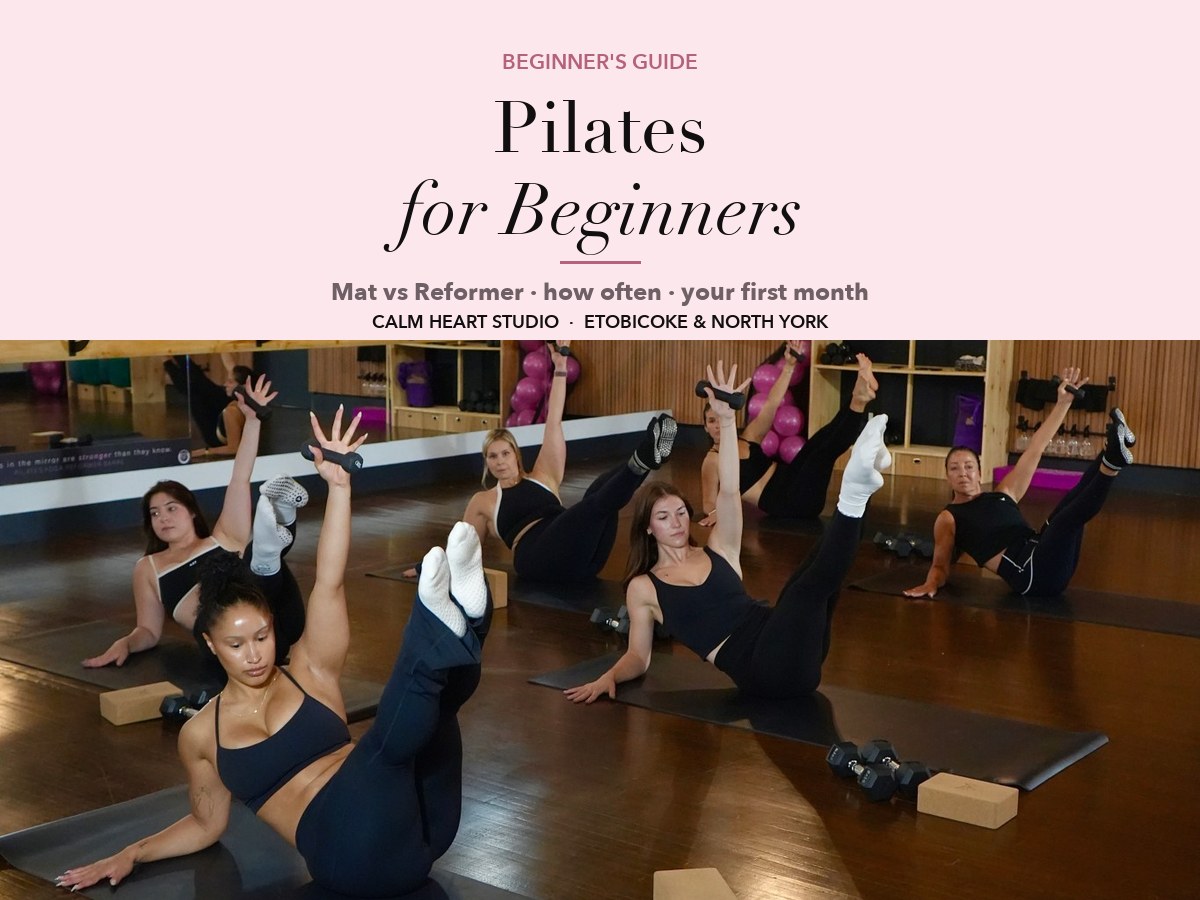
Pilates is one of the most beginner-friendly ways to build strength. It’s low-impact, every exercise can be modified, and you don’t need to be flexible or fit to start. Most beginners begin with mat Pilates to learn the basics, or an all-levels Reformer class where the instructor walks you through the machine. Start with two classes a week: most people feel a real difference after three to five classes.
This guide covers what Pilates is, how mat and Reformer differ, how hard it really is, how often to go, and a simple plan for your first month.
Key takeaways – Pilates is a low-impact method focused on core strength, control, posture and breath. – No experience, flexibility or special fitness level is needed. Every class can be modified. – Mat Pilates teaches the foundations; Reformer adds spring resistance and support. – Start with two classes a week. Consistency matters more than intensity. – Most people feel a real difference after three to five classes.
What is Pilates?
Pilates is a system of controlled, low-impact exercises developed by Joseph Pilates in the early 20th century. It focuses on strengthening the deep muscles of your core (your abdominals, back, hips and pelvic floor) while improving posture, mobility and body awareness.
Every Pilates class is built on a few simple principles:
- Breath: each movement is paired with your breathing.
- Control: you move slowly and deliberately, rather than relying on momentum.
- Centring: movement starts from your core.
- Precision: small, correct movements matter more than big ones.
- Flow: exercises link smoothly from one to the next.
You can do Pilates on a mat, using your body weight and small props, or on equipment like the Reformer, a sliding carriage with springs, straps and a foot bar.
Is Pilates good for beginners?
Yes. Pilates is one of the easiest forms of exercise to start from scratch because:
- It’s low-impact. There’s no jumping or running, so it’s gentle on your joints.
- Every exercise can be modified. Instructors give easier and harder options, so a first-timer and a regular can take the same class.
- It builds the basics other workouts assume you have: core strength, balance, posture and body awareness.
- You don’t need to be flexible. Pilates builds flexibility and strength from day one.
At Calm Heart, classes are small enough that instructors can watch your form and tailor movements to your body.
Is Pilates hard?
Pilates is challenging but approachable. The movements look simple, but doing them slowly and with control works muscles you may not be used to using. It’s normal to feel your core, glutes and inner thighs working hard, and even to shake a little.
Some soreness the next day is normal. Sharp pain is not. If something hurts, stop and tell your instructor so they can adjust the exercise.
As you get stronger, the same exercises feel smoother, and you can progress with more repetitions, more spring resistance or harder variations.
Mat vs Reformer Pilates: which should beginners start with?
Both are great for beginners. Here’s how they compare:
| Mat Pilates | Reformer Pilates | |
|---|---|---|
| Equipment | A mat and small props | The Reformer: a sliding carriage with springs, straps and a foot bar |
| Resistance | Your body weight | Adjustable springs that can make exercises harder or give you support |
| Best for | Learning the core principles and control | Full-body strength with guidance from the machine |
| First class tip | The classic starting point | Mention it’s your first time; your instructor will walk you through the machine before you start |
Our advice: many people start with mat Pilates to learn the foundations, then add Reformer once they know the basic cues. If the Reformer is what drew you in, start with an all-levels Reformer class and let your instructor know you’re new. You’ll be shown how everything works before class begins.
What Pilates helps you build
With regular practice, Pilates is designed to strengthen and improve:
- Core strength: the deep abdominal and back muscles that support everyday movement
- Posture: stronger postural muscles and better awareness of how you sit and stand
- Flexibility and mobility: controlled movement through a full range of motion
- Balance and stability: especially through your hips and pelvis
- Body awareness: knowing how to move well, which carries over into other workouts and daily life
- Mind and body connection: the focus on breath and control makes many people feel calmer after class
If you have an injury, are pregnant or have a health condition, check with your healthcare provider before starting, and email us before you book so your instructor can plan modifications.
5 foundational moves you’ll learn early
These are some of the first exercises you’re likely to meet in a beginner class. Your instructor will guide you through them; this is just so the names won’t be new.
- Breathing and the neutral spine. Lying on your back with knees bent, you’ll practise breathing wide into your ribs while keeping your pelvis and spine in a neutral position. Almost every exercise builds on this.
- Pelvic curl. You lift your hips by peeling your spine off the mat one vertebra at a time, then lower back down. It’s a gentle way to warm up the spine, glutes and hamstrings.
- The Hundred. A classic warm-up: you pump your arms while breathing in for five counts and out for five, for 100 counts. Beginners keep their feet down or legs in tabletop.
- Single-leg stretch. With your head and shoulders lifted, you alternate drawing one knee in while extending the other leg. It works your core and coordination.
- Footwork (Reformer). Lying on the carriage with your feet on the foot bar, you press out and return with control. It’s usually the first exercise in a Reformer class and helps you get a feel for the springs.
How often should beginners do Pilates?
Start with two classes a week. That’s enough to build momentum without being sore all the time, and most people feel a real difference after three to five classes. Consistency beats intensity, every time.
Once your body adapts, you can add a third session or mix in other classes such as yoga, barre or weight training.
Your first month: a simple plan
| Week | What to do |
|---|---|
| Week 1 | Two mat Pilates classes. Focus on breath and the basic positions, not on doing everything perfectly. |
| Week 2 | One mat class and one all-levels Reformer class. Tell your instructor it’s your first time on the Reformer. |
| Week 3 | Two or three classes. Try a different class time or instructor to find what suits you. |
| Week 4 | Keep two to three classes a week. Notice what feels easier than in week 1. |
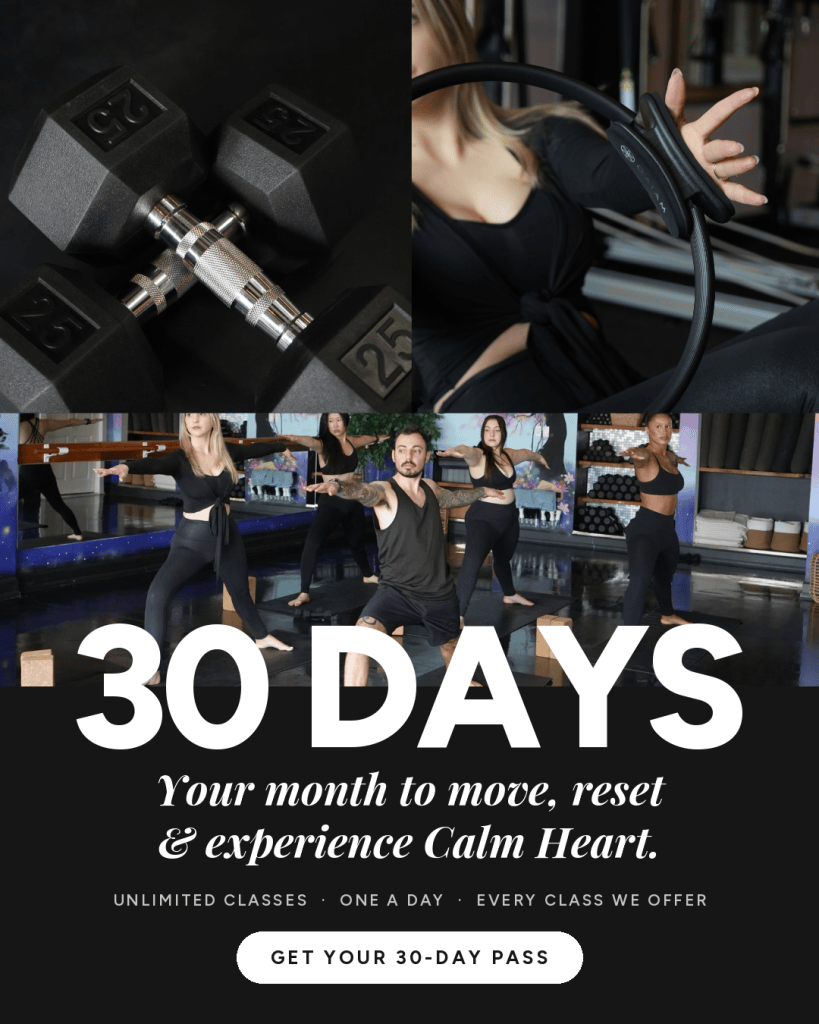
Our 30 Days of Calm pass is made for this: 30 days of unlimited classes (one class per day), valid for every class we offer, with no membership commitment.
Common beginner mistakes (and how to avoid them)
- Holding your breath. Breathing is part of every exercise. If you lose track, slow down and breathe.
- Going too fast. Slow and controlled is harder, and better, than fast.
- Pushing through pain. Effort and shaking are normal; sharp pain is a signal to stop and tell your instructor.
- Comparing yourself to others. Everyone in the room started somewhere. Take the modification you need.
- Wearing loose clothing. Fitted clothes are more comfortable and won’t catch on the Reformer. See our guide on what to wear to Pilates.
- Skipping weeks. Two classes every week will get you further than five classes once a month.
“Every one of us started as a beginner. Come in, breathe, take the modification you need, and come back next week. That’s how strength is built.”
— Gabriella Arce Rodriguez and Marianna Arce Rodriguez, founders of Calm Heart Studio
Frequently asked questions
Do I need to be fit or flexible to start Pilates?
No. Pilates builds strength and flexibility from day one, and every exercise has easier options.
Is Reformer Pilates good for beginners?
Yes. The springs can make exercises harder, but they can also support you. Choose an all-levels class and tell your instructor it’s your first time; they’ll walk you through the machine before class.
How long until I see results from Pilates?
Most people feel a difference after three to five classes, often in their posture, core strength and how their body feels day to day. Visible changes take longer and depend on how often you practise.
Can I do Pilates if I have an injury?
Often, yes, with the right modifications. Check with your healthcare provider first, then email us before you book and arrive a few minutes early so your instructor can plan for you.
Is Pilates better than yoga?
They’re different, and many people do both. Pilates focuses on core strength and controlled movement; yoga focuses on flexibility, balance and breath. At Calm Heart you can try both, along with barre and weight training.
What should I bring to my first class?
Comfortable, form-fitting clothes, a water bottle and grip socks for Reformer (available at our front desk for $10). We provide mats, props and all equipment.
Ready to start Pilates in Toronto?
Calm Heart Studio has two studios for beginners: Calm Heart Lakeshore in Etobicoke and Calm Heart Wilson in North York.
- Read our first-class guide for how to book, when to arrive and what to expect.
- Try everything with our 30 Days of Calm pass: 30 days of unlimited classes, one class per day.
- See all our Pilates, yoga and barre classes.
About the authors: Gabriella Arce Rodriguez is the founder of Calm Heart Studio, with more than 15 years in the fitness industry and certifications in yoga, mat and Reformer Pilates, TRX and barre. Read Gabriella’s full bio. Marianna Arce Rodriguez specializes in Reformer, Chair, Tower, Spring Board and Mat Pilates. Meet the full team on our Instructors page.
Leave a Reply