
By Gabriella Arce Rodriguez and Marianna Arce Rodriguez, founders of Calm Heart Studio
Pilates and yoga are both low-impact, mind-body practices, but they lead with different goals. Pilates is built around core strength, control and posture, using small, precise movements on a mat or a Reformer. Yoga is built around flexibility, balance and breath, moving through poses that are often held or linked in a flow. If you want to get stronger and more stable, start with Pilates. If you want to loosen up and slow your mind down, start with yoga. Most people get the best results from doing both.
We teach both at Calm Heart Studio. Gabriella has completed a 500-hour yoga teacher training and holds Mat and Reformer Pilates instructor certifications. Here’s how we explain the difference to members trying to decide.
Key takeaways
- Pilates focuses on core strength, control and posture. Yoga focuses on flexibility, balance and breath.
- Both are low-impact, beginner-friendly and can be modified for any level.
- Pilates usually feels like strength training; vinyasa yoga feels like a flowing, full-body practice with a calmer finish.
- Choose Pilates to build strength and stability, and yoga to build mobility and calm.
- They work best together: try two Pilates classes and one yoga class a week.
Pilates vs yoga at a glance
| Pilates | Yoga | |
|---|---|---|
| Where it comes from | Developed by Joseph Pilates in the early 20th century | An ancient practice from India, thousands of years old |
| Main focus | Core strength, control, posture and alignment | Flexibility, balance, breath and mindfulness |
| How you move | Controlled repetitions that start from your core | Poses held for a few breaths or linked in a flow |
| Breathing | Breathe in through the nose, out through the mouth, wide into the ribs | Usually in and out through the nose, often a slow, steady breath |
| Equipment | A mat and small props, or machines like the Reformer | A mat, with blocks and straps for support |
| How it feels | Like strength training: you feel specific muscles working | Like a moving meditation: stretching, heat and a calm finish |
| Best for | Building strength, stability and better posture | Building mobility, balance and stress relief |
What is Pilates?
Pilates is a system of controlled, low-impact exercises that strengthen the deep muscles of your core: your abdominals, back, hips and pelvic floor. Each movement is slow and precise, paired with your breath and started from your centre.
You can do Pilates on a mat, using your body weight and small props, or on the Reformer, a sliding carriage with springs, straps and a foot bar. The springs can add resistance to make an exercise harder or give support to make it easier, which is why the Reformer suits beginners and advanced members alike.
New to it? Read our Pilates for beginners guide.
What is yoga?
Yoga is an ancient practice that combines physical postures, breathing and focus. There are many styles, from slow, restorative classes to faster, flowing ones.
At Calm Heart, we teach vinyasa yoga, where each movement is linked to an inhale or an exhale so the class flows from one pose to the next. It builds strength and heat, works on mobility and balance, and usually ends with a few quiet minutes of rest.
5 key differences between Pilates and yoga
- The goal. Pilates trains your body to move with strength and control. Yoga trains flexibility and balance, and treats the mind and breath as part of the practice.
- The breath. In Pilates you breathe wide into your ribs to support your core as you move. In yoga, breath sets the rhythm of the flow and helps you settle into each pose.
- The movement. Pilates uses controlled repetitions of an exercise, often eight to ten. Yoga moves through a sequence of poses, some held for several breaths.
- The equipment. Yoga needs only a mat and a few props. Pilates can be done on a mat, but it also uses equipment like the Reformer and the Chair to add resistance and support.
- The finish. A Pilates class tends to end with you feeling worked, especially through your core. A yoga class tends to end with you feeling stretched, open and calm.
What each one is best for
Both practices build strength, flexibility and body awareness. The difference is where each one leads.
- Core strength: Pilates. Almost every exercise is designed around your deep core muscles.
- Flexibility and mobility: yoga. Holding and flowing through poses takes your joints through a wide range of motion.
- Posture: Pilates has the edge, because it strengthens the muscles that hold you upright. Yoga helps by opening tight hips, chest and shoulders.
- Balance: both. Yoga trains it through standing poses; Pilates through core stability.
- Stress and mental calm: yoga leads, with its focus on breath and its quiet finish. Many people find Pilates calming too, because it takes total concentration.
- Full-body toning: Reformer Pilates. The springs add resistance, so it works like strength training while staying low-impact.
Which should you choose?
| If you want to… | Start with |
|---|---|
| Build core strength and get stronger | Pilates, especially Reformer |
| Become more flexible | Yoga |
| Improve your posture after long days at a desk | Pilates, plus yoga for tight hips and shoulders |
| Manage stress and switch off | Yoga |
| Add a low-impact workout alongside running, lifting or sports | Pilates for stability, yoga for mobility |
| Start exercising again after a long break | Mat Pilates or a gentle all-levels yoga class |
If you have an injury, are pregnant or have a health condition, check with your healthcare provider before starting either practice, and email us before you book so your instructor can plan modifications.
Is Pilates harder than yoga?
Neither is harder. It depends on the class and on your body. Pilates often feels harder for people with a strong yoga practice, because it works small, deep muscles they’re not used to targeting. Yoga often feels harder for people who are strong but tight, because it asks for flexibility and balance.
A flowing vinyasa class can raise your heart rate more than a slow mat Pilates class, and a Reformer class can feel more like strength training than either. The best way to find out is to try one of each.
Can you do Pilates and yoga together?
Yes, and we recommend it. Pilates gives you the core strength to hold yoga poses with better alignment. Yoga gives you the mobility to move through Pilates exercises with a fuller range of motion. You can even do both on the same day, if you listen to your body.
A simple weekly mix for most people:
| Your goal | A balanced week |
|---|---|
| Get stronger | 2 Reformer Pilates classes + 1 vinyasa yoga class |
| Get more flexible | 2 vinyasa yoga classes + 1 mat Pilates class |
| Feel better overall | 1 Reformer, 1 mat Pilates and 1 vinyasa yoga class |
Start with two or three classes a week. Consistency matters more than intensity.
“We don’t ask members to choose. Pilates makes you strong from the centre, yoga gives you space to breathe and move freely, and together they make you feel at home in your body.”
— Gabriella Arce Rodriguez and Marianna Arce Rodriguez, founders of Calm Heart Studio
Frequently asked questions
Is Pilates or yoga better for beginners?
Both are beginner-friendly, and every class at Calm Heart offers modifications. If you’re not sure, start with mat Pilates to learn how to engage your core, then add a yoga class once you feel comfortable. The core control you build in Pilates will help you in every yoga pose.
Is Pilates a type of yoga?
No. Pilates is a separate method created by Joseph Pilates, who drew on several disciplines, including yoga, gymnastics and martial arts. The two share a focus on breath and body awareness, but the exercises and goals are different.
Do I need to be flexible to do yoga or Pilates?
No. Flexibility is something both practices build, not something you need before you start. Your instructor will show you easier options for any pose or exercise.
Which is better for flexibility, Pilates or yoga?
Yoga, because it spends more time stretching and holding poses. Pilates improves flexibility too, especially through controlled movement in your spine and hips.
What should I wear to Pilates and yoga?
Comfortable, form-fitting clothes for both. For Reformer Pilates, wear grip socks (available at our front desk for $10). Yoga is usually practised barefoot. See our guide on what to wear to Pilates.
Try both at Calm Heart Studio
You don’t have to choose. Both of our studios, Calm Heart Lakeshore in Etobicoke and Calm Heart Wilson in North York, offer Reformer Pilates, mat Pilates and Signature Vinyasa yoga, along with barre and weight training.
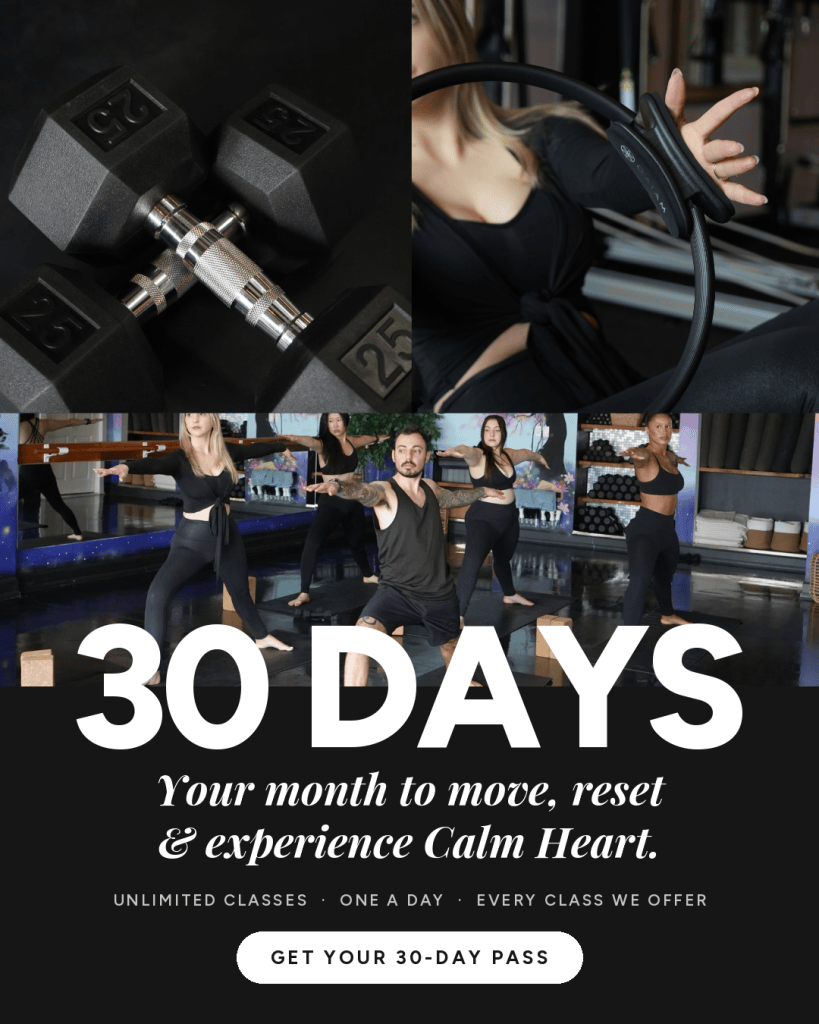
- Try everything with our 30 Days of Calm pass: 30 days of unlimited classes, one class per day, valid for every class we offer.
- Read our first-class guide for how to book and what to expect.
- See all our Pilates, yoga and barre classes.
About the authors: Gabriella Arce Rodriguez is the founder of Calm Heart Studio, with more than 15 years in the fitness industry, a 500-hour yoga teacher training and certifications in mat and Reformer Pilates, TRX and barre. Read Gabriella’s full bio. Marianna Arce Rodriguez specializes in Reformer, Chair, Tower, Spring Board and Mat Pilates. Meet the full team on our Instructors page.
Leave a Reply